

Non-Resident Capital Gains Tax: Why a Red Book Valuation Matters When Selling UK Property
If you are a non-UK resident selling or disposing of UK property, you may need to report and pay Non-Resident Capital Gains Tax, often shortened to NRCGT.
This can apply whether the property is residential, commercial, mixed-use, or land. HMRC guidance states that non-residents must report disposals of UK property or land, and that UK property disposals generally need to be reported and paid within 60 days of completion.
For many overseas owners, one of the most important parts of the calculation is establishing the correct market value of the property at the relevant date. This is where a professional RICS Red Book valuation can be extremely important.
At The Valuation Hub, we provide independent Capital Gains Tax valuations for UK property owners, including non-resident clients who require a clear and robust valuation report for tax purposes.
For more information, visit our Capital Gains Tax Valuations page.

What is Non-Resident Capital Gains Tax?
Non-Resident Capital Gains Tax applies where a person who is not UK resident sells or disposes of UK property or land and makes a chargeable gain.
A “disposal” does not only mean a straightforward sale. It can also include certain transfers, gifts, or other situations where ownership changes. The tax is usually based on the gain, not the full sale price.
For non-residents, HMRC guidance confirms that disposals of UK property and land must be reported, even where there may be no tax to pay.
This means that even if you believe there is little or no gain, it is still important to consider your reporting obligations and to take tax advice where required.
Why does the valuation date matter?
For NRCGT, the relevant valuation date can be critical.
In many cases, non-resident owners need to consider the value of the property at a historic date, rather than simply using the original purchase price. For residential property, 5 April 2015 is often a key date because NRCGT was introduced for UK residential property from April 2015. HMRC guidance refers to calculating the taxable gain or loss for non-residents, including the use of rebasing in relevant circumstances.
For example, if you owned a UK residential property before April 2015 and later sold it while non-resident, your accountant may ask for a valuation as at 5 April 2015 to help calculate the gain arising during the taxable period.
Common NRCGT valuation dates may include:
5 April 2015 for residential property rebasing.
5 April 2019 in some non-residential or mixed-use cases.
The date of acquisition, where relevant.
The date of disposal or transfer, where market value is required.
A date specified by your accountant or tax adviser.
The correct date will depend on your circumstances, so it is important to confirm this with your accountant before instructing the valuation.

Why is a Red Book valuation important for NRCGT?
A Red Book valuation is a formal valuation prepared in accordance with the RICS Valuation – Global Standards, commonly known as the Red Book. RICS states that the Red Book contains mandatory rules and best practice guidance for RICS members undertaking valuation services.
For NRCGT purposes, a Red Book valuation can provide:
An independent market value opinion
The valuation is prepared by a suitably qualified surveyor, rather than being based on an informal estimate, online valuation, estate agent appraisal, or guess.
A clear valuation date
The report will state the specific valuation date being adopted, which is especially important for historic NRCGT calculations.
Comparable evidence
The surveyor will consider relevant market evidence, including comparable sales where available.
A professional report for your tax file
A Red Book report gives your accountant or tax adviser a formal valuation document to retain and refer to when preparing the NRCGT calculation.
Greater support if HMRC queries the figure
HMRC can check valuations used for Capital Gains Tax purposes. A properly prepared RICS valuation gives you a stronger evidential basis than relying on an informal estimate.
Why online estimates and estate agent appraisals may not be enough
Online valuation tools can be useful for a rough indication, but they are not designed to provide a formal market value opinion for tax purposes.
Similarly, an estate agent appraisal may be useful for marketing a property, but it is not the same as a Red Book valuation. An agent’s appraisal is often prepared with a sale in mind, whereas an NRCGT valuation needs to assess market value at a specific date, often retrospectively.
This is particularly important where:
The valuation date is historic.
The property has changed condition since the valuation date.
The property has been extended or refurbished.
The market moved significantly between the valuation date and the sale date.
The property is unusual, high-value, rural, listed, or otherwise difficult to compare.
You are relying on the valuation to reduce or support a tax liability.
For NRCGT, the difference between a weak valuation and a well-supported valuation can have a direct financial impact.
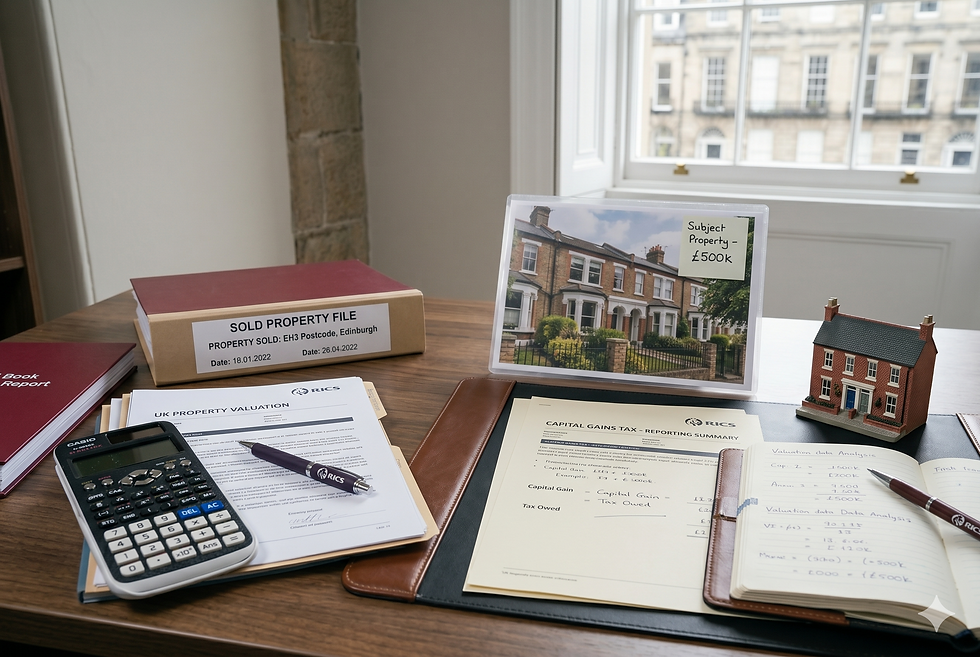
Example: why a 5 April 2015 valuation can matter
Imagine an overseas owner purchased a UK flat many years ago and sold it in 2026.
If the property was already owned before the introduction of NRCGT for residential property, the accountant may need to establish the property’s market value as at 5 April 2015. The taxable gain may then be calculated by reference to the gain from that date, depending on the method used and the owner’s circumstances.
A small difference in the 2015 valuation can materially affect the taxable gain.
For example:
Sale price in 2026: £450,000
Estimated 5 April 2015 value: £300,000
Potential gain before adjustments: £150,000
If the 2015 value was understated at £275,000, the apparent gain could increase to £175,000 before other adjustments.
That is why it is important to use a valuation that is properly researched, reasoned, and prepared in accordance with professional standards.
What information is needed for an NRCGT valuation?
For a desktop Red Book valuation, we would typically ask for:
The full property address.
The required valuation date.
The purpose of valuation, for example NRCGT or Capital Gains Tax.
The date of purchase and date of sale, if available.
Sale price or expected sale price.
Property type, size, accommodation, tenure, and condition.
Floorplans, Home Report, sales particulars, or historic records where available.
Details of improvements, extensions, or alterations.
Confirmation of whether the property was tenanted or vacant at the valuation date.
Any specific instructions from your accountant or tax adviser.
The more accurate the information, the stronger the valuation report is likely to be.
Can an NRCGT valuation be done remotely?
In many cases, yes.
A desktop Capital Gains Tax valuation can often be prepared remotely where there is sufficient information available. This may include property records, mapping, historic sales evidence, listing details, client-provided information, and market comparables.
However, some properties may require a site inspection, particularly where the property is unusual, has limited market evidence, has been significantly altered, or where condition is a major valuation factor.
At The Valuation Hub, we can advise whether a desktop valuation is likely to be suitable based on the property and the information available.
Should I speak to an accountant first?
Yes. A surveyor provides the valuation, but does not calculate your tax liability or advise on tax structuring.
Before instructing a valuation, it is sensible to confirm with your accountant:
The correct valuation date.
Whether a rebased value is required.
Whether any other calculation method is being considered.
Whether the property was residential, non-residential, or mixed-use for NRCGT purposes.
Whether any reliefs, allowances, losses, or improvement costs may apply.
Once the valuation date and purpose are confirmed, a RICS valuation can be prepared to support the calculation.
How The Valuation Hub can help
The Valuation Hub provides RICS Red Book Capital Gains Tax valuations for clients across Scotland and the wider UK, including non-resident property owners.
We can assist with:
Non-Resident Capital Gains Tax valuations
5 April 2015 property valuations
Retrospective Capital Gains Tax valuations
Probate and inheritance-related valuation work
Market value reports for accountants, solicitors, and private clients
Our reports are prepared by an MRICS Chartered Surveyor and RICS Registered Valuer, giving you a professional valuation report suitable for your tax records and accountant.
For more information, please visit our Capital Gains Tax Valuations page or contact The Valuation Hub to discuss your property.
FAQs
Do I need a Red Book valuation for NRCGT?
It is not always legally mandatory to obtain a Red Book valuation, but it is often strongly advisable. If the value is important to your tax calculation, a formal RICS Red Book valuation provides a much stronger basis than an online estimate or informal appraisal.
What date is used for Non-Resident Capital Gains Tax valuations?
The valuation date depends on the property and the circumstances. For many residential properties owned before April 2015, 5 April 2015 may be relevant. Your accountant should confirm the correct date before the valuation is instructed.
Can HMRC challenge my property valuation?
Yes. HMRC can check valuations used for Capital Gains Tax purposes. This is one reason why a professionally prepared valuation report can be important.
Can you provide a desktop NRCGT valuation?
Yes, in many cases a desktop Red Book valuation may be suitable, provided sufficient information and comparable evidence are available. More complex or unusual properties may require a site inspection.
Who should instruct the valuation — me or my accountant?
Either can make the initial enquiry, but the valuation instructions should be clear. We commonly work with private clients, accountants, and solicitors where a formal Market Value is needed for tax purposes.


Comments